

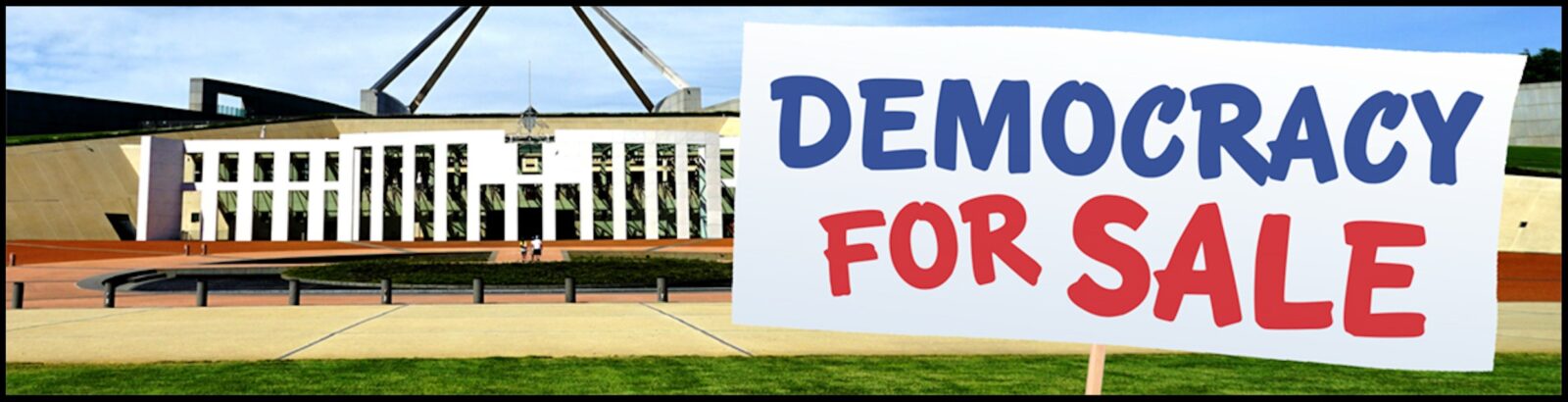
As long as billionaires dress down and speak rough, they can speak with a loud hailer and burn money to inflate their interests, writes Professor Graeme Orr…
FEATURE
Mining magnate Gina Rinehart and close associates have reportedly gifted over $3 million to the One Nation Party in the last financial year. In cash and even an entire aircraft.
‘Reportedly’ – as none of this has to be declared publicly until February 2027.
Clive Palmer splurged over $260m on electioneering at the last three national polls, and then some. The land of the ‘fair go’ has never been as egalitarian as it thinks. As long as billionaires dress down and speak rough, they can speak with a loud hailer and burn money to inflate their interests.
Yet even before the billionaires, Australia had a money-in-electoral-politics problem. The two parties of government, Labor and Liberal, have been running business ‘forums’ or ‘networks’ and charging over $100,000 for membership, permitting access to front-benchers at regular gatherings.
The electoral commission even held, bafflingly, that these sums were not disclosable ‘gifts’, because they bought something of value. That is the very form of privileged access that most citizens believe corrupts the democratic process.
“That is the very form of privileged access that most citizens believe corrupts the democratic process”
Current national laws are laissez-faire, by world standards. Disclosure, as noted, is rooted in an untimely model from the paper-and-pen era of the 1980s.
And it only applies to ‘gifts’ over $17,300pa. Unlike the majority of states, there have been no caps on donations – aside from recent bans on ‘foreign source’ donations, inspired by fears of Chinese influence. Nor have there been caps on national electioneering spending.
Please consider supporting The Klaxon here

The Australian Electoral Commission (AEC) has quietly executed mass censorship of political donations data. Source: The Klaxon
Hence the Rinehart, Palmer and party network examples have all been lawful. And parties at the national level have long enjoyed public funding. ‘Clean money’: but it has been extra cream rather than compensation for any limits.
That legal permissiveness is set to change, from sometime next year. For the first time, party and lobby group electioneering at national elections will be capped. So too will donations. Disclosure of donations will be at a lower level, and closer to ‘real-time’. The change has been a long time coming.
The new laws – around 250 pages, including transitional rules – were the result of protracted negotiations across 2024. They passed in early 2025 with support from the Coalition. One upside of this is that buy-in, from both major parties, means the principles underlying caps and transparency are accepted for the foreseeable future.
This doesn’t mean the laws are ideal. The Greens support the principles, but (rightly) decry that the caps are too generous. The headline cap prevents donations of more than $50,000 to one political entity.
But that obscures the ability to donate that amount to each division of a nationally organised party, several of its candidates and even a couple of sympathetic lobby groups. The effective cap is more like $1.6m per annum.
The spending cap will be $90m for a national party. Roughly at the Palmer level, which in his hands was both a record, and a turnoff for voters. Within that total cap, there is a limit of $800,000 per targeted, marginal seat campaign.
The ‘Teal’ independents say that all the caps need redrafting, alleging unfairness to them. Party candidates benefit from the nationwide spending of their party, promoting its brand, policies and leadership. Also, parties can fund that wider campaign with multiple donations from a single source, something independents cannot.
There is a legitimate concern that rules shouldn’t artificially shield established parties, at a time when party politics is realigning.
Lobby groups will face an $11.25m ‘electioneering’ cap. So sugar daddies of the Teals will be able to do background electioneering supporting them. Interest groups will also still be able to mount unlimited single interest campaigns, providing they just promote their policy interests rather than boosting or attacking parties or candidates.
“The limits under the new laws are exceedingly generous”
All-in-all, the new laws are better than nothing, if far from ideal. First, the limits are exceedingly generous. No-one wants parties to be starved of resources. Party democracy beats billionaires directly campaigning – like Bloomberg and Musk in the US. Party machines, however derided, have an ongoing interest in their long-term reputation.
Channelling donations through them, in the Australian way, insulates against corruption. It is far easier to buy a self-interested individual politician, as US experience also shows.

Pauline Hanson with an aircraft reportedly gifted to One Nation by mining multi-billionaire Gina Rinehart. Source: Twitter/X
New election funding laws are welcome but too complex
The new laws will dampen the ability of incumbent and business friendly parties to rely on mega-donations, from corporations or unions, into their campaign budgets. In return, the regime will ramp up public funding to $5 per vote – or $10 per elector given we have House and Senate votes. In addition, mimicking state practice, parties (and independent MPs) will get a second flow of subsidies.
In the form of ‘administrative’ assistance, paid at a metric based on the number of Commonwealth MPs they have.
Second, the new laws are unduly complex. Admittedly, regulating the flow of money is hard. There are waterbed effects. So, to mix metaphors, regulation engages in a cat-and-mouse game. But these laws numb my brain, and I’ve spent 30 years studying the area. Parties, especially small or new ones, rely on volunteers at ground level not all can afford legal advice.
The electoral commission will do well to focus not on missteps by small fry, but on lurks by the well-to-do and well-advised.

The mass censorship of “donations” data by the AEC followed action by Don Farrell, the architect of the ALP’s electoral reforms. Source: The Klaxon
Finally, why is there a two-year delay for the new restraints and obligations to come into effect? The official explanation is that the commission needs time to gear up the new disclosure portal and educate itself and others as to the new complexities. One doesn’t have to be too cynical, though, to suspect another motive.
Seeing Rinehart shower big money on One Nation – and its explosion in the polls – the major parties want time to catch up, to fill their election coffers ahead of a late 2027 or early 2028 poll. As St Augustine quipped, ‘Lord make me chaste; just not yet’.
“Seeing Rinehart shower big money on One Nation – and its explosion in the polls – the major parties want time to catch up”
One thing to watch for is unintended effects. Will big money just reappear in other guises? Palmer, capped in what he can give to his own party, may just run more oblique campaigns directly through a corporate vehicle. Unions and business groups too may campaign more nakedly to help Labor and the Coalition. Astro-turfed groups may appear to strain the law.
Ultimately, there is no perfect regime of regulating money in electoral politics. Integrity values, the ideals of political equality and liberty, and the pragmatic need for fair party resourcing, have to be accommodated. Being part of a cat-and-mouse game, the new laws will inevitably be revisited by the end of the decade.
Graeme Orr is an emeritus professor in law at the University of Queensland.
Quality independent journalism is vital to our democracy. Please consider supporting us for as little as $10 a month, or by making a one-off donation of any amount here.
Thank you,
Anthony Klan
Editor, The Klaxon

