

If South Australia’s ban on political donations survives any potential High Court challenge, the model could be replicated more broadly, writes Associate Professor Yee-Fui Ng.
South Australia is the first democratic jurisdiction to impose a full ban on political donations in 2024, which came into operation for the 2026 South Australian election.
This is essentially a system of full public funding of political parties, with limited exceptions. Premier Peter Malinauskas trumpeted this reform as being ‘world-leading’.
Other Australian jurisdictions regulate political finance as well through a combination of low caps on donations, caps on expenditure, bans on foreign donations, and bans on donations from property developers, tobacco industry business entities, and liquor and gambling businesses.
But a complete ban on donations is certainly unprecedented.
Over the span of its history, South Australia has been a strong democratic incubator. Historically, SA was a pioneer of the secret ballot and the second jurisdiction in the world to enfranchise women, behind New Zealand, and SA was the first jurisdiction to introduce novel truth in political advertising laws in 1985.
The donations ban is yet another novel regime introduced by the State.
Why ban donations?
The full ban on donations is at face value surprising. It is against politicians’ interests to disallow themselves from bolstering their coffers to improve their electoral prospects. And there was no scandal that formed the impetus for this change.
The Premier’s explanation for this ban was two-fold. First, the intention is to help ensure that ‘election campaigns are a contest of ideas, not a contest of money’.
The second purpose is to ‘level the playing field so all participants in the political process have access to an appropriate degree of funding relative to their level of support within the community’, and to ‘diminish the likelihood that a campaign war chest size informs the outcome’.
Thus, the ban on donations seeks to reduce the influence of money in politics and to equalise the playing field between political parties, including major parties, minor or new parties, and independents.
The ban on donations is accompanied by an increase of public funding that hinges on the number of votes at the last election. To balance between public funding of established parties and MPs and the interests of new entrants or those operating at lower-scale, public funding per vote for independents is enhanced compared to that paid to registered parties.
Please consider supporting The Klaxon here

South Australian ALP Premier Peter Malinauskas introduced the laws in 2024. Picture: Hilary Wardaugh/AAP
So, why is it desirable to ban donations?
There are four guiding principles for regulating political finance. First, electoral politics needs resources, and political parties cannot be starved of funding. Second, political financing needs to minimise the dangers of corruption and conflicts of interest.
Third, political finance must promote fair competition between electoral entities. This invokes a broader ideal of political equality. The concept of competition necessarily implies a fourth concern with political participation and liberty. Politics needs to be responsive to the values and interests of a wide variety of people and groups.
In terms of SA’s donations ban, the ultimate question is whether restricting political parties to only public funding will be as healthy for electoral democracy as its proponents hope.
On the one hand, public money is seen to be ‘clean’ money, devoid of the corrupting influence that can attach to funds given by rich individuals or corporations.
On the other hand, by removing from political parties and candidates the need to raise money, this may create complacent political actors and parties that are less responsive to the electorate. There is also a risk of inhibiting experimentation and evolution in party structures and activities.
With only one election so far under the new law, it is still too early to know how this will play out, and how a ban will impact on the operation of political parties in SA in the longer run.
Is a full ban on donations constitutional?
Another open question is whether the SA scheme is constitutional. Our Constitution protects the implied freedom of political communication, which means that political finance regimes that infringe these principles will be struck down as unlawful, as occurred in Victoria in 2026.
A ban on donations from property developers in NSW has been held to be constitutional due to the history of corruption implicating property developers in that State. However, it is unclear whether the High Court will consider a full ban on donations to be proportionate.
Conclusion
The struggle for political equality has shaped Australian democracy. South Australia has taken a bold step forward in banning donations. If the donations law survives any potential High Court challenge, this may prove to be an administratively simple model that could be adopted in other jurisdictions.
Yee-Fui Ng is an Associate Professor at Monash University with a research focus on strengthening political institutions and enhancing executive accountability.
This article is first published by The Klaxon and 360info.org
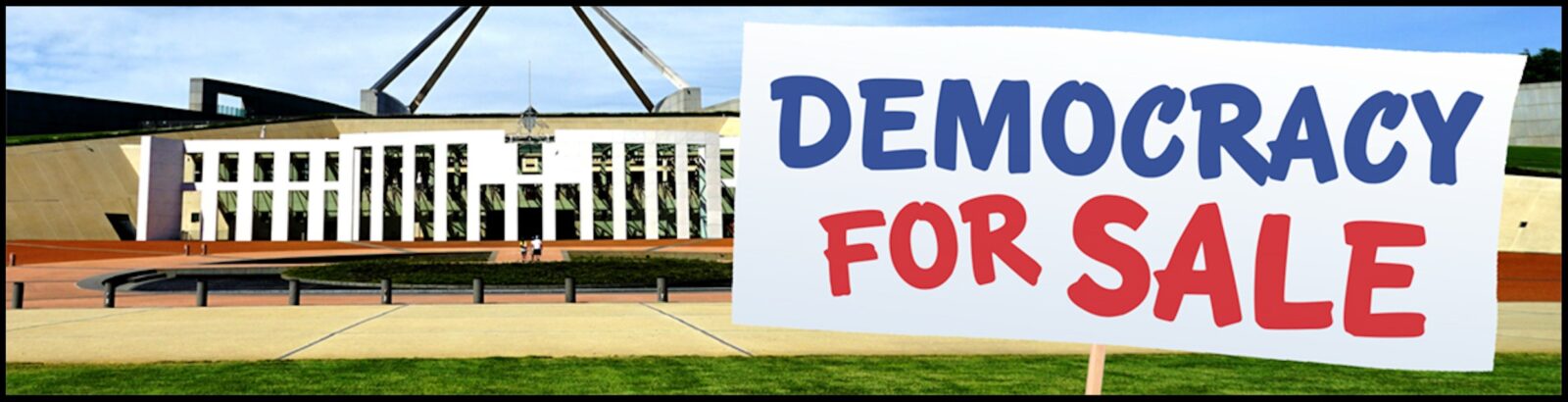
You can read the rest of our Democracy for Sale series here.
Quality independent journalism is vital to our democracy. Please consider supporting us for as little as $10 a month, or by making a one-off donation of any amount here.
Thank you,
Anthony Klan
Editor, The Klaxon


