

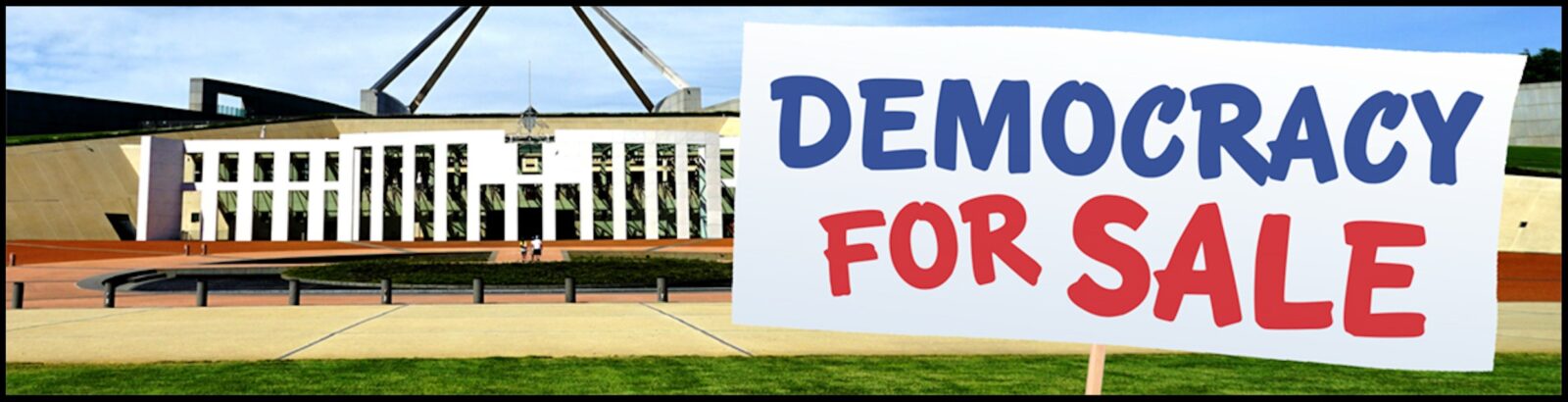
Big Alcohol is using same playbook as tobacco to thwart public policy, with the endless revolving door underpinning its “complex webs of influence”, reports Professor Peter Miller.
FEATURE
When it comes to the alcohol companies seeking to buy influence, fundraising dinners with the Prime Minster and other politicians are just the tip of the ice-berg. At $10,000 a seat, it’s hardly democracy and sausage sizzles.
Alcohol lobbyists and venues play a major role in selling democracy. The alcohol industry has long been masters of weaving complex webs of influence to ensure their product is not treated as the “primary cause of more than 200 diseases and injuries and globally results in approximately 3.3 million deaths each year, greater than HIV/AIDS, violence or tuberculosis.”
About 77 per cent of Australian adults (aged 14 and over) consume alcohol, and roughly one in three drinkers exceed national health guidelines.
According to the Australian Institute of Health and Welfare, alcohol remains a leading cause of preventable hospitalisations and health burdens nationwide. Of course, there is substantial overlap with other sectors such as gambling, restaurants and sport (one of their most politically powerful alliances)
This isn’t one bad dinner. It is just how the system works: patient and effective.
Indeed, it is directly based on the tobacco industry’s playbook, as documented by Bond and colleagues in 2009 showing how SAB Miller brewing was supplied with coaching manuals on how to delay effective policy by the tobacco company Philip Morris, who at the time controlled the brewing company, which has now morphed into the global giant Anheuser-Busch InBev SA/NV that owns over 200 beer brands.
“SAB Miller brewing was supplied with coaching manuals on how to delay effective policy by the tobacco company Philip Morris”
At the time, it controlled Carlton & United Breweries (CUB) which has since been sold off to Asahi Group Holdings. The industry is a global cabal of 5 companies which produce around 60% of the world’s beer, who trade companies, staff and strategies.
Money buys access
The Australian Hotels Association (AHA) has donated around $4 million to Labor and almost $3m to Liberal in the past 12 years. The pub lobby is not funding one side to win a single vote. It funds relationships.
Our research team interviewed insiders about donations in a study whose title borrowed a politician’s blunt summary: “If someone donates $1000, they support you. If they donate $100,000, they’ve bought you.”
“The AHA has donated around $4 million to Labor and almost $3m to Liberal in the past 12 years”
Industry money rarely asks for anything crude. It buys a seat at the table, a phone that gets answered, and a minister who already knows your name.
Please consider supporting The Klaxon here

AHA national president David Basheer. The AHA donates millions of dollars to the Labor and Liberal parties. Source: AHA
A long game, not a single deal
The most effective lobbying doesn’t start when a bill is introduced. It starts years earlier, by backing promising politicians early in their careers. By the time they hold power, they have a decade of goodwill, hospitality and friendship behind them.
Research on the “revolving door” shows the other end of this process. Industry builds relationships on the way up, then hires the people who hold them on the way out.
The revolving door
In 2019, we examined the Australian Government Register of Lobbyists. Of the 569 people listed, 206 (36%) said they were former government representatives.
For the 122 whose job histories we could trace:
- About 18% were former MPs or Senators.
- About 47% were former chiefs of staff or senior advisers.
- 45% had spent more than a decade in government.
These are people who know how decisions get made, who makes them, and what the minister’s office needs to hear.
“These are people who know…what the minister’s office needs to hear”
One interviewee described the effect plainly. A person who had met a ministerial chief of staff as an industry lobbyist six months earlier now found that same person working in the minister’s office.
That, they said “amplifies the disparity and the influence between the industry and the community sector”.
Paul Nicolaou, a former senior NSW Liberal fundraiser, became CEO of the Australian Hotels Association NSW. He said publicly that with a Liberal government in power you wouldn’t appoint someone with Labor ties.
A former federal Labor minister went on to work for a company with a major shareholding in Crown Casino. A chief of staff to a federal health minister co-owned a lobbying firm that had represented major food companies.
Since then the Northern territory has seen the head of Hospitality NT, Alex Bruce, employed as the Chief Minister’s Chief of staff. His replacement at Hospitality NT worked for former Premier Daniel Andrews in Victoria, as did another current senior AHA executive in Victoria.
The Territory’s world-leading Minimum Unit Price was rapidly retired, despite evidence of its impact.
The Territory’s world-leading Minimum Unit Price was rapidly retired, despite evidence of its impact
The rules that should prevent this are weak. Federal ministers face an 18-month cooling-off period before lobbying in related areas, and other members face 12 months. In Canada the ban is five years.
We also can’t see much of this activity as our earlier study of Australia’s lobbyist registers found that none required in-house lobbyists to register, none recorded informal lobbying, and none described what lobbying actually took place.
Registrars often refused or delayed requests for historical data. The registers give the appearance of transparency without much substance.
“The registers give the appearance of transparency without much substance”

AHA’s “corporate partners”. Source: AHA
Corporate social responsibility as camouflage
The industry also works hard to look responsible. Its most important marketing tool in Australia is DrinkWise.
DrinkWise was established in 2005 with $5 million from the alcohol industry and $5 million from the Liberal federal government. It presents itself as a body for changing Australia’s drinking culture. But when we examined it, we found:
- Six of DrinkWise’s 10 board members came from the alcohol industry.
- Its website barely mentioned its industry backing.
- Its focus was education and social marketing, approaches that systematic reviews show do little to reduce alcohol harm.
- It funded no work on measures that do work, such as higher alcohol taxes, which the industry opposes.
Its logo also appeared for three seconds at the end of TV ads, which helped the industry and the organisation look responsible.
“The alcohol industry’s most important marketing tool in Australia is DrinkWise”

The DrinkiWise website. Source: DrinkWise
In my research, I couldn’t find a single example of DrinkWise ever supporting mandatory labelling to warn pregnant women of the harms of drinking, but numerous examples of its alcohol industry funders proposing DrinkWise as an alternative to these labels.
When investigating submissions regarding marketing alcohol, especially to children, the industry’s own words show how it is used.
When we analysed submissions to the government’s review of alcohol marketing regulation, six of the eight industry submissions used “corporate social responsibility” arguments. Four cited membership of DrinkWise as proof of good intentions.
The same submissions argued that the voluntary system works well; there is no strong evidence that marketing increases drinking (except of course the millions the industry spends), and; the real problem is a small minority of drinkers who should be handled with education.
The marketing code they praised is overseen by a committee with industry representatives, and breaching it carries no penalty.
“An independent panel upheld 68 per cent of complaints – the industry scheme upheld 7 per cent”
Six of the eight submissions also attacked public health experts as biased. That tactic is borrowed from the tobacco playbook: if you can’t win on evidence, challenge the people presenting it. A classic strategy used by the Merchants of Doubt.
Taken together, the tobacco industry picture is consistent: donate and sponsor, so decision-makers know who you are; hire the insiders, so you know how decisions get made; fund a friendly face, so you look like part of the solution; argue “more research is needed,” so nothing changes.
“Taken together, the tobacco industry picture is consistent: donate and sponsor, hire the insiders, fund a friendly face, argue more research is needed”
None of it is a single act that would make headlines. The scale and persistence are the point, and those make it so hard to see and so hard to counter.
The way forward
The fixes are not mysterious, and have long been known by government and political parties:
Real-time donation disclosure with far lower thresholds; mandatory registration of all lobbyists, including in-house ones, with detail on who they met and why; cooling-off periods of at least four years, with penalties that are enforced; and government funding that is independent of industry-backed groups like DrinkWise.
Until then, expect more cheerful nights out sponsored by the people with the most to profit from keeping things as they are.
Peter Miller is Professor of Violence Prevention and Addiction Studies, Deakin University.
This article is first published by The Klaxon and 360info.org
You can read the rest of our Democracy for Sale series here.
Quality independent journalism is vital to our democracy. Please consider supporting us for as little as $10 a month, or by making a one-off donation of any amount here.
Thank you,
Anthony Klan
Editor, The Klaxon


